![JAPAN VISA [YOKOYAMA LEGAL SERVICE OFFICE]](https://lawoffice-yokoyama.com/wp/wp-content/uploads/2014/10/logo_024.png)
Japan Tightens Permanent Residency Rules: Why Now Is the Time to Switch from “Engineer/Specialist in Humanities/International Services” to the Highly Skilled Professional Visa (HSP)
コンテンツ
- [Breaking News Analysis] Permanent Residency Requirements to Tighten—Transitional Measures Treating “3 Years of Residence as Maximum” Set to Be Abolished.
- Reasons to Switch from Engineer/Specialist in Humanities/International Services Visa to Highly Skilled Professional (HSP) Visa Now
- The Critical Change: Abolition of the “3-Year Visa = Longest Period” Special Treatment
- Why does staying on a Engineer/Specialist in Humanities/International Services Visa increase risk now?
- Engineer/Specialist in Humanities/International Services Visas rarely grant 5-year residency periods (3 years is standard)
- The Highly Skilled Professional (HSP) Visa grants 5 years from the start (no 3-year option exists)
- Another key point in stricter permanent residency screening: “Renewal denied for unpaid social insurance premiums”
- What should you do if considering permanent residency?
- Summary: The tightening of permanent residency requirements has already begun.
- Please feel free to contact us for advice!
[Breaking News Analysis] Permanent Residency Requirements to Tighten—Transitional Measures Treating “3 Years of Residence as Maximum” Set to Be Abolished.
Reasons to Switch from Engineer/Specialist in Humanities/International Services Visa to Highly Skilled Professional (HSP) Visa Now
Japan Tightens Permanent Residency Rules: Why Now Is the Time to Switch from “Engineer/Specialist in Humanities/International Services” to the Highly Skilled Professional Visa (HSP)?
In December 2024, Yahoo Japan reported that the Japanese government, under Prime Minister Sanae Takaichi, is preparing major changes to the immigration system, including stricter requirements for Permanent Residency (PR) and tighter control over the largest visa categories—Permanent Resident and Engineer/Specialist in Humanities/International Services (技術・人文知識・国際業務, commonly known as “Gijinkoku”).
Among the upcoming reforms, one change has a direct and significant impact on foreign professionals aiming for Permanent Residency:
The Critical Change: Abolition of the “3-Year Visa = Longest Period” Special Treatment
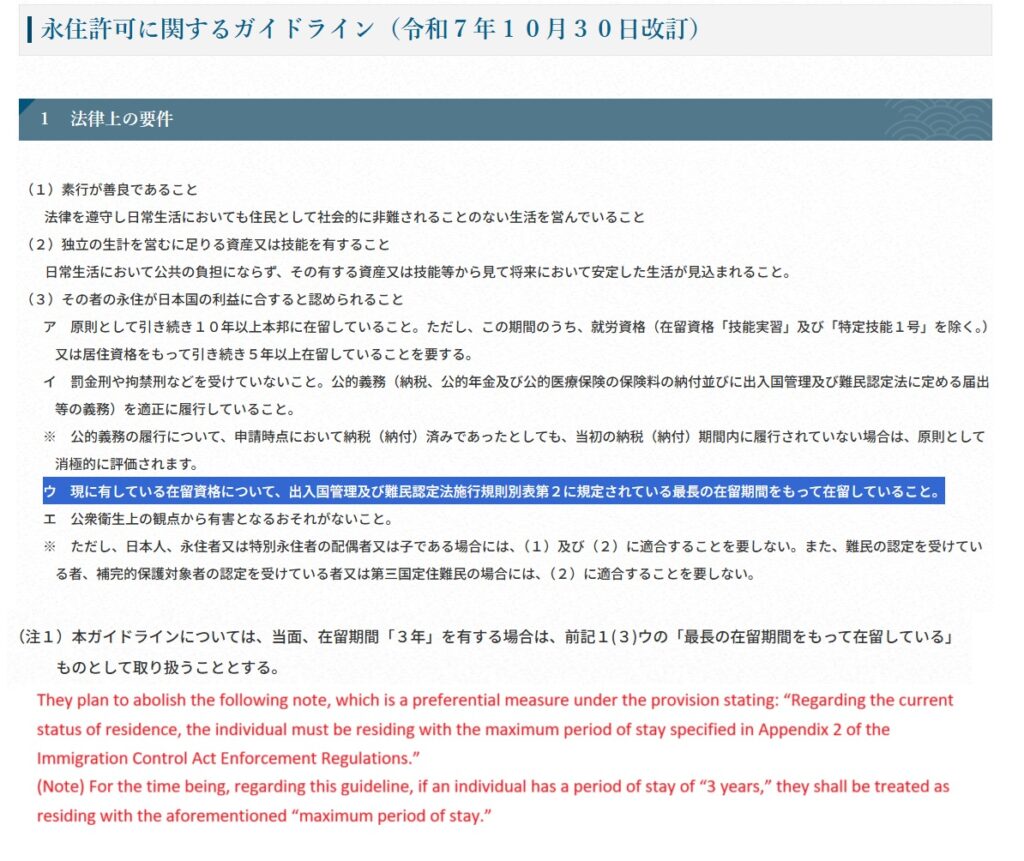
Japan’s PR Guidelines (revised on 30 October 2025) include the requirement:
The applicant must currently hold the longest period of stay prescribed for the status of residence.
For Japan work visas, the longest period is 5 years. Until now, immigration authorities applied a special rule:
(Note) For the time being, a “3-year” period of stay will be treated as equivalent to the longest period.
Yahoo Japan reports that the government is now preparing to abolish this exception.
Particularly crucial in this report is that the following treatment, considered “the most lenient” within the permanent residency guidelines, is set to be abolished.
Abolition of the transitional measure: Treating 3-year visa holders as having the maximum stay period (5 years)
This means: A 3-year visa will NO LONGER satisfy the PR requirement. Only a 5-year visa will.
This change alone will dramatically affect thousands of Gijinkoku visa holders.
Consequently, the route of “3-year visa → permanent residency application” will be closed going forward. It is expected that “already having a 5-year period of stay” will become mandatory for permanent residency applications.
Why does staying on a Engineer/Specialist in Humanities/International Services Visa increase risk now?
As noted in Yahoo News, Engineer/Specialist in Humanities/International Services Visas have surged 1.6 times over the past five years. Due to issues with unauthorized activities, immigration authorities are intensifying screening. Furthermore, the following points become “directly disadvantageous” in permanent residency screening:
Engineer/Specialist in Humanities/International Services Visas rarely grant 5-year residency periods (3 years is standard)
Company size, annual income, job duties, personnel systems… For many Engineer/Specialist in Humanities/International Services Visa applicants, 3 years is the maximum. However, if the transitional measures are abolished,
Permanent residency cannot be applied for unless you actually obtain 5 years
The path to permanent residency becomes significantly longer.
The Highly Skilled Professional (HSP) Visa grants 5 years from the start (no 3-year option exists)
Under the Ministry of Justice’s system, the Highly Skilled Professional visa offers only the “5-year” option.
In other words,
- Engineer/Specialist in Humanities/International Services Visa → (3 years) → Takes several more years to obtain 5 years.
- Highly Skilled Professional Visa → (From the start) 5 years
This creates a significant gap at the starting line for permanent residency applications.
With permanent residency requirements tightening, switching to the Highly Skilled Professional Visa—which guarantees a 5-year stay—is practically the “Strongest Route” to pursue.
For Highly Skilled Professional Visa requirements and application support, see here.
The following points in the current policy draft are also critical:
- A direction to deny residence renewal or change if social insurance premiums or taxes are unpaid
- Automatic tracking of unpaid status via My Number starting fiscal year 2027
In other words, even if “the company made a procedural error and failed to enroll,” the individual could face liability.
This particularly impacts Engineer/Specialist in Humanities/International Services Visa and is a frequent issue in practical consultations.
What should you do if considering permanent residency?
“Doing nothing while holding a Engineer/Specialist in Humanities/International Services Visa” will become increasingly risky going forward.
Summarizing the direction indicated by this report:
| Requirement / Risk | Engineer/Specialist in Humanities/International Services Visa (技人国) | Highly Skilled Professional Visa (HSP) |
| Maximum period of stay | 5 years, but difficult for SMEs to obtain | Always 5 years (from initial issuance). Even SMEs will be granted 5 years. |
| Possession of the visa with the maximum residence period required for permanent residency application | 3-year visa is not acceptable (transitional measures abolished) | Meets visa requirements from the outset. |
| Impact of unpaid social insurance | Increased risk of non-renewal | Stronger against non-renewal |
| Company system review | Weak | Strong (company creditworthiness is reviewed) |
Conclusion:
To increase certainty of obtaining permanent residency, switching from a Engineer/Specialist in Humanities/International Services Visa to a Highly Skilled Professional Visa is currently the most effective option.
People who should especially prioritize switching:
- Those currently on a Technical/Humanities/International Services visa with a 3-year or 1-year period of stay
- Those aiming to apply for permanent residency within 2-3 years
- Those likely to score 70 points or more on the Highly Skilled Professional points system
- IT professionals, engineers, researchers, executives, interpreters—those qualifying as highly skilled professionals.
If you fall into these categories, switching to the Highly Skilled Professional Visa acts as “insurance against missing out on permanent residency.”
Details on the Highly Skilled Professional Visa (Requirements, Point Calculation, Application Examples)
Summary: The tightening of permanent residency requirements has already begun.
Switching to the Highly Skilled Professional Visa early is the best route.
- The transitional measure treating the “3-year visa as the maximum duration” has been abolished.
- Effectively ushering in an era where “Permanent Residency = 5-Year Visa Required”
- Discussions intensify on stricter screening and acceptance caps for Technical/Humanities/International Services visas
- Social insurance non-payment now leads to renewal denial
- With the Highly Skilled Professional Visa, you immediately clear one permanent residency requirement from the start with a 5-year visa
For those wishing to work long-term in Japan or aiming for permanent residency, switching to the Highly Skilled Professional Visa now is the most rational and reliable choice.
Please feel free to contact us for advice!
First, please call +81-3-6264-9388 or leave a message on our website with your inquiry. (Please contact us by phone or consultation page.)
TEL: +81-3-6264-9388
WeChat: visa_hengshan
Line ID: visa_yokoyama
Email: info@lawoffice-yokoyama.com