![JAPAN VISA [YOKOYAMA LEGAL SERVICE OFFICE]](https://lawoffice-yokoyama.com/wp/wp-content/uploads/2014/10/logo_024.png)
Japan Plans to Tighten Permanent Residency Rules for Foreign Nationals
コンテンツ
- Permanent Residency Rules
- Japan Plans to Tighten Permanent Residency Rules for Foreign Nationals
- Language Skills, Income Standards, and Integration Requirements Under Review
- Key Policy Changes Under Consideration
- 1. Japanese Language Requirement for Permanent Residency
- 2. Income Standards May Be Clearly Defined
- 3. Longer Residency Requirement for Naturalization
- 4. “Legal and Cultural Learning Program”: Likely a Reuse of Existing Frameworks
- Existing Model: Business Manager Visa Renewal
- 5. Stricter Enforcement of Tax and Social Insurance Compliance
- 6. Student Part-Time Work Rules to Be Tighter
- 7. Real Estate: Monitoring Without Immediate Restrictions
- What Remains Undecided
- Practical Takeaway
Permanent Residency Rules
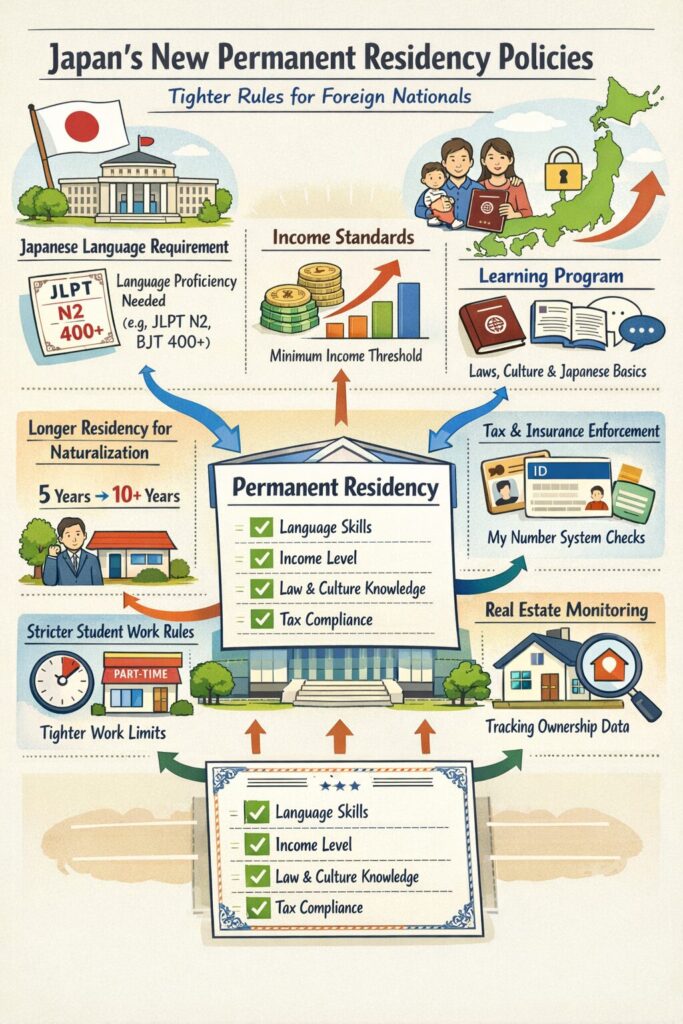
This article is based on current media reporting and policy discussions. Final policy details may change. Some analysis reflects professional interpretation.
Japan Plans to Tighten Permanent Residency Rules for Foreign Nationals
Language Skills, Income Standards, and Integration Requirements Under Review
The Government of Japan is preparing a new basic policy on foreign residents, expected to be finalized as early as January 2026.
According to recent media reports, the policy will significantly reshape Japan’s permanent residency and naturalization framework, with a strong focus on language ability, economic self-sufficiency, and social integration.
Below is a clear, practical overview of the main measures currently under discussion.
Key Policy Changes Under Consideration
1. Japanese Language Requirement for Permanent Residency
Japan is considering adding Japanese language proficiency as an explicit requirement for permanent residency.
Traditionally, permanent residency decisions were based on three main pillars:
-
Length of residence
-
Stable livelihood and income
-
Good conduct
Unlike naturalization, Japanese language ability was not formally required. This may change as policymakers increasingly emphasize smooth communication, administrative understanding, and community integration.
At this stage, no specific language level has been announced.
2. Income Standards May Be Clearly Defined
The government is also discussing the introduction of explicit income thresholds for permanent residency applications.
If implemented, this would raise the practical bar for applicants by placing greater weight on long-term financial stability.
3. Longer Residency Requirement for Naturalization
For Japanese nationality applications, the minimum residency period may be extended from:
-
5 years → 10 years in principle
This would align naturalization more closely with permanent residency standards.
4. “Legal and Cultural Learning Program”: Likely a Reuse of Existing Frameworks
Media reports suggest that, from FY 2027, foreign residents may be required to learn:
-
Japanese laws and administrative systems
-
Social rules and daily-life norms
-
Basic Japanese language skills
Completion of such learning may become a condition for permanent residency applications or certain visa renewals.
However, it is important to note that Japan’s immigration policy has historically not relied on stand-alone, government-run training programs exclusively for foreigners.
In practice, it is far more likely that immigration authorities will repurpose or expand existing compliance-based frameworks, rather than create a new classroom-style program.
Existing Model: Business Manager Visa Renewal
A clear precedent already exists in the Business Manager visa system.
Under current rules, renewal requires that either the applicant or a full-time employee demonstrate sufficient Japanese proficiency.
This is defined as B2 level or above under the Japanese Language Education Reference Framework, and may be proven through objective criteria, such as:
-
JLPT N2 or higher
-
400 points or more on the BJT Business Japanese Test
-
20 years or more of mid- to long-term residence in Japan
-
Graduation from a Japanese university or higher education institution
-
Completion of Japanese compulsory education and high school
Importantly, no attendance at a specific government course is required.
Based on this pattern, future permanent residency screening is likely to focus on measurable outcomes, not mandatory participation in a single standardized program.
5. Stricter Enforcement of Tax and Social Insurance Compliance
To address unpaid taxes, insurance premiums, and medical costs:
-
Residence Cards and My Number Cards will be integrated from June 2026
-
Data sharing between national and local governments will begin from 2027
-
Serious non-compliance may result in denial of entry or visa renewal
The use of My Number will also be expanded to prevent improper receipt of social benefits.
6. Student Part-Time Work Rules to Be Tighter
The current system, where broad work permission is granted at entry, may be revised.
Authorities are considering stricter monitoring of working hours and activities to prevent illegal employment.
7. Real Estate: Monitoring Without Immediate Restrictions
A centralized database tracking property owners’ nationality is planned from FY 2027.
However, no immediate restrictions on foreign real estate purchases have been decided.
What Remains Undecided
At present, the following points remain unclear:
-
The exact Japanese language level required
-
Whether existing permanent residents will be affected
-
Concrete income thresholds
-
Final implementation dates
Most measures are still under policy discussion, with details expected to be finalized before April 2027, when related immigration law amendments take effect.
Practical Takeaway
Japan’s direction is becoming clear:
Permanent residency is increasingly treated as proof of long-term functional integration, not merely length of stay.
Foreign residents considering permanent residency or naturalization should begin planning with a focus on:
-
Demonstrable Japanese language ability
-
Stable and well-documented income
-
Full compliance with tax and social insurance obligations
-
Long-term residency strategy (PR vs. naturalization)
This article is based on current media reporting and policy discussions. Final policy details may change. Some analysis reflects professional interpretation.