![JAPAN VISA [YOKOYAMA LEGAL SERVICE OFFICE]](https://lawoffice-yokoyama.com/wp/wp-content/uploads/2014/10/logo_024.png)
Business Manager Visa Denials Are Rising in Japan — How Foreign Entrepreneurs Can Protect Their Children’s Education
The Sharp Rise in Business Manager Visa Denials in Japan
How to Protect Your Child’s Education When Your Visa Is at Risk
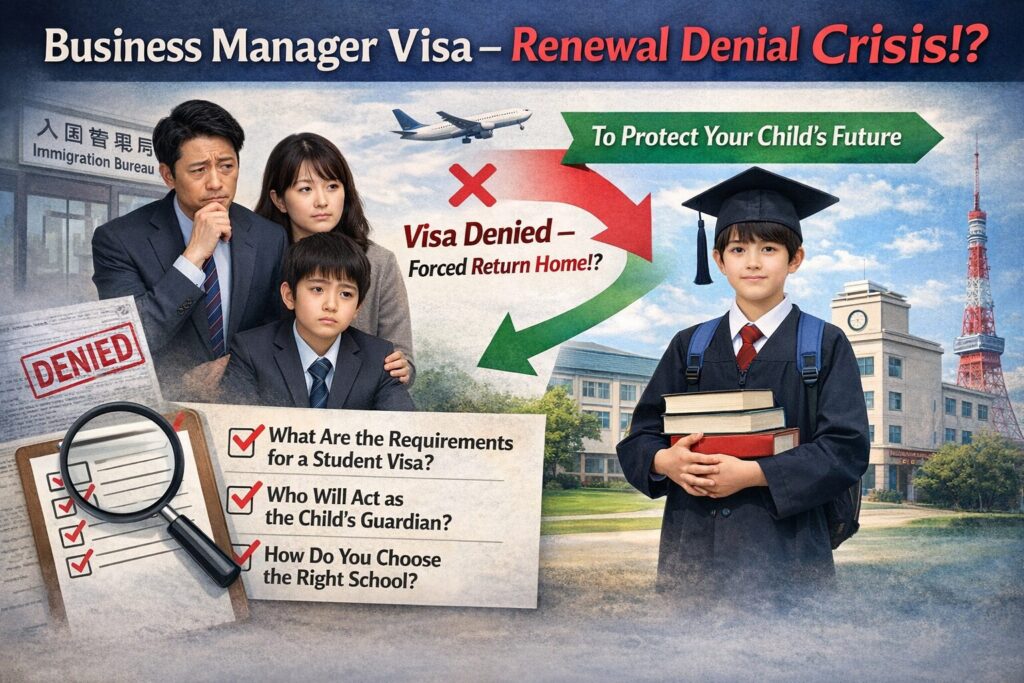
In recent years, a growing number of foreign entrepreneurs in Japan have faced an unexpected and deeply unsettling outcome: the denial of their Business Manager visa renewal. Many of these individuals had operated legitimate businesses for years and had renewed their visas without issue—until suddenly, they were told “not permitted.”
This is no longer an isolated phenomenon. Since October 16, 2025, when Japan’s Ministry of Justice implemented a major tightening of the Business Manager visa requirements, the landscape has fundamentally changed. What was once a relatively accessible status for small-scale foreign entrepreneurs has been transformed into a highly selective residency category reserved only for businesses that demonstrate substantial scale, sustainability, and economic contribution to Japan.
For business owners with families—especially children enrolled in Japanese schools—the consequences extend far beyond business continuity. A single visa denial can place an entire family’s life in Japan at risk.
The Business Manager Visa After October 16, 2025: A Different Legal Reality
Under the previous framework, it was often possible to obtain or renew a Business Manager visa with capital of around JPY 5 million, provided that a basic business presence could be demonstrated. That assumption no longer applies.
The new standards introduced in October 2025 radically altered the requirements. The minimum capital requirement has increased sixfold, from JPY 5 million to JPY 30 million. In addition, at least one full-time employee is now mandatory. Crucially, this employee must be a Japanese national or a permanent resident; foreign employees holding standard work visas no longer qualify.
The business plan itself must now be evaluated by certified professionals such as licensed tax accountants, certified public accountants, or SME consultants. Immigration authorities assess not only profitability but also sustainability, growth potential, and social contribution. Concept-level or lifestyle businesses are no longer sufficient.
Office requirements have also become stricter. One-person rental offices and home offices are generally rejected. A dedicated, fully operational office space is now expected. Furthermore, the applicant must demonstrate either more than three years of management experience or an academic background equivalent to a master’s degree.
In effect, the Business Manager visa has become a status for established enterprises rather than individual entrepreneurs.
Why Even Legitimate Businesses Are Being Rejected
The purpose of this reform is explicit: to eliminate paper companies and nominal businesses that contribute little to the Japanese economy. Business models focused primarily on asset holding—such as passive real estate ownership or outsourced short-term rental management—are now frequently categorized as lacking genuine management activity.
As a result, even companies with proper incorporation and tax filings may be denied renewal if immigration authorities determine that there is insufficient “management substance.”
A three-year transitional period applies to those who already held a Business Manager visa as of October 16, 2025. However, this is not an exemption. It is merely a grace period. At the time of renewal, full compliance with the new standards will be required. Without preparation, denial is only a matter of time.
The Risk of Fixating on the Business Manager Visa Alone
Many business owners initially believe that their only option is to restructure their business to meet the new criteria. In theory, this is correct. In practice, it is often unrealistic.
Raising JPY 30 million in capital within a short time frame is not feasible for many families. Hiring full-time Japanese staff is difficult in Japan’s current labor market. Some business models simply do not align with the new expectations, regardless of effort.
For families with children, continuing to pursue an unattainable Business Manager renewal can be dangerous. When a parent’s visa is denied, dependent family visas are also lost. This can force children to leave Japan mid-education.
For this reason, one alternative has proven to be both realistic and effective: switching the child’s status to a Student visa.
The Student Visa as a Practical Way to Protect Your Child’s Education
Student visas in Japan are not limited to university students or language school attendees. Elementary, junior high, and high school students can also obtain Student visas, provided that strict conditions are met.
When properly structured, a Student visa can be renewed repeatedly, potentially allowing a child to remain in Japan through graduation and even onward to higher education. However, the younger the child, the higher the scrutiny.
For high school students, the requirements are relatively straightforward. The applicant must be under 20 years old and have at least one year of Japanese-language or Japanese-medium education. For students who already have a foundation in Japanese, this route is often realistic.
For junior high and elementary students, the situation is far more complex.
Why Younger Students Face Much Higher Barriers
When parents cannot remain in Japan, immigration authorities focus intensely on the child’s living environment. A minor cannot simply attend school without a clearly defined guardian structure.
Authorities require proof of a responsible guardian in Japan—such as a relative, dorm supervisor, or host family—who can oversee daily life. The school must have staff responsible for student welfare, and appropriate accommodation with on-site supervision must be secured.
In practice, approvals are rare unless the child can live with a close relative already residing in Japan or in a well-established boarding facility accustomed to hosting foreign students. Although Japanese-language education is not formally required by statute, applications are frequently rejected when the child has no functional Japanese ability, unless there is a demonstrated history of schooling in Japan.
School cooperation is equally critical. Many public schools are unwilling to sponsor non-resident foreign students. As a result, private schools are often the only viable option. Without a school willing to act as sponsor, a Student visa application cannot proceed.
A Real Case: How Early Planning Saved a Child’s Future in Japan
One family supported by our office illustrates how effective early action can be.
The child was attending high school in Japan under a Dependent visa. The parent held a Business Manager visa but anticipated eventual business downsizing due to regulatory changes. The child was accepted into a vocational school in Tokyo after graduation. At the time, the family lived in Saitama, and relocation was inevitable.
Instead of waiting for a denial, the family acted proactively. The parent applied for a Business Manager renewal that accounted for business winding-down activities. Simultaneously, the child applied to change status from Dependent to Student in line with vocational school enrollment.
Despite living separately, we carefully documented the business reality, educational necessity, and independent living arrangements. Both applications were approved.
Several years later, the parent closed the business and returned to their home country. The child remained in Japan, continued renewing the Student visa, and successfully graduated. Had the family waited until after a visa denial, the child would almost certainly have been forced to leave Japan mid-education
The Core Lesson: Timing Determines Your Options
This case succeeded not because of luck, but because of timing. Visa strategy is not about reacting to denial; it is about designing viable pathways before denial occurs.
For younger children, additional support structures are required. For older students, independence makes planning easier. In every case, immigration decisions evaluate not only documents, but the realism of the family’s life plan.
Japan does not offer a “guardian stay visa” for parents of student minors. A child’s Student visa does not allow a parent to remain in Japan. Families must therefore confront a difficult but necessary question: whether to prioritize living together or the child’s education in Japan.
There is no universally correct answer. But there is one absolute truth: once a Business Manager visa is denied, most alternatives disappear due to lack of time.
Why Early Consultation Matters More Than Ever
Japan’s Business Manager visa standards are unlikely to loosen. In practice, enforcement continues to tighten each year. Many clients later tell us, “If only we had consulted earlier, we would have had more options.”
Our role is not merely to file applications. We assess whether continuing a Business Manager visa is realistic, whether employment-based alternatives exist, and whether a child’s Student visa can be structured safely. Immigration strategy is family strategy.
If you are beginning to feel uncertain about your next renewal, your business trajectory, or your child’s education, that uncertainty itself is the signal to act. The earlier the planning begins, the more choices remain.
Your family’s future in Japan should not be decided by a last-minute rejection. It should be designed—calmly, strategically, and in time.
Useful Link
- Amendments to the Ministerial Ordinance on Landing Standards for the “Business Manager” Visa (11 Oct. 2025)
- Overview of Japan Business Manager Visa
Other Question?

Please feel free to contact us for advice!
First, please call +81-3-6264-9388 or leave a message on our website with your inquiry. (Please contact us by phone or consultation page.)
TEL: +81-3-6264-9388
WeChat: visa_hengshan
Line ID: visa_yokoyama
Email: info@lawoffice-yokoyama.com