![JAPAN VISA [YOKOYAMA LEGAL SERVICE OFFICE]](https://lawoffice-yokoyama.com/wp/wp-content/uploads/2014/10/logo_024.png)
コンテンツ
- Designated Activities Visa
- Overview of the Designated Activities Status of Residence
- Number of Foreign Residents Holding a Designated Activities Visa
- Period of Stay
- Two Main Types of Designated Activities Visas
- 1. Notified Designated Activities
- What Are Notified Designated Activities?
- Examples of Notified Designated Activities
- 2. Non-Notified Designated Activities
- What Are Non-Notified Designated Activities?
- Typical Examples
- Special Examples of Non-Notified Designated Activities
- Designated Activities (Preparation for Departure)
- Designated Activities for Parental Support (No Longer Available)
- Certificate of Eligibility (COE): Important Distinction
- List of Notified Designated Activities (Excerpt)
- Important Notes
- Need Professional Advice?
Designated Activities Visa
Overview of the Designated Activities Status of Residence
The “Designated Activities” visa is a special status of residence granted to foreign nationals whose intended activities in Japan do not fall under any of the standard visa categories, such as work visas (e.g. Engineer/Specialist in Humanities/International Services), other activity-based visas (e.g. Student), or family-based visas (e.g. Spouse or Child of a Japanese National).
Under this status, the Minister of Justice designates specific activities on a case-by-case basis, allowing entry into and residence in Japan for purposes that cannot be appropriately covered by existing visa classifications.
Because of its flexible nature, the Designated Activities visa is used in a wide variety of situations, including job-hunting after graduation, working in highly specialized or exceptional roles, long-term tourism, and humanitarian or policy-based cases.
Number of Foreign Residents Holding a Designated Activities Visa
The number of foreign residents in Japan holding a Designated Activities visa has fluctuated in recent years:
| Date (End of Year) | Number of Holders |
|---|---|
| December 2022 | 83,380 |
| December 2023 | 73,774 |
| December 2024 | 95,508 |
This increase reflects the growing use of this visa category to address diverse and non-standard residence needs.
Period of Stay
The permitted period of stay under a Designated Activities visa may be:
-
5 years
-
3 years
-
1 year
-
6 months
-
3 months
-
or another period individually designated by the Minister of Justice (not exceeding 5 years)
The length granted depends entirely on the nature of the designated activity and the applicant’s individual circumstances.
Two Main Types of Designated Activities Visas
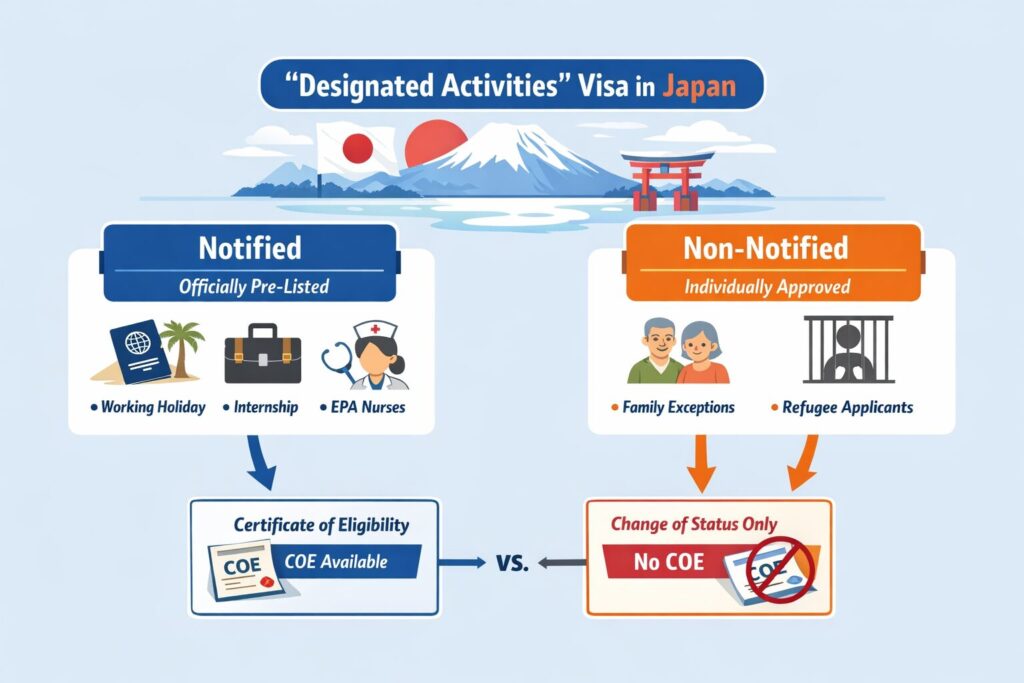
Designated Activities visas are broadly divided into two categories:
-
Notified Designated Activities
-
Non-Notified Designated Activities
Understanding this distinction is crucial, as it affects both eligibility and application procedures.
1. Notified Designated Activities
What Are Notified Designated Activities?
Notified Designated Activities are activities that the Minister of Justice has pre-designated and publicly announced through official notifications (Japanese: kokuji 告示).
If a foreign national intends to engage in one of these officially listed activities, immigration authorities may grant the Designated Activities status upon confirming that the landing conditions are satisfied, pursuant to Article 7, Paragraph 1, Item 2 of the Immigration Control and Refugee Recognition Act.
Examples of Notified Designated Activities
Typical examples include:
-
Private servants employed by diplomats or consular officials
-
Participants in the Working Holiday Program
-
Foreign amateur sports athletes employed by companies
-
Foreign university students participating in internships or corporate training programs
-
EPA (Economic Partnership Agreement) nurse and care worker candidates
2. Non-Notified Designated Activities
What Are Non-Notified Designated Activities?
Non-Notified Designated Activities are activities not listed in official notifications, but which the Minister of Justice has previously approved on an individual basis and determined may be appropriate to approve again in similar future cases.
These visas are granted only through an application for Change of Status of Residence and are not eligible for a Certificate of Eligibility (COE).
Typical Examples
Non-Notified Designated Activities may include:
-
Residence of relatives (such as parents or grandchildren) who do not qualify for the “Dependent” visa
-
Temporary stay during the processing of a refugee recognition application
-
Special humanitarian permission for rejected refugee applicants
-
Continued job-hunting activities after graduating from a Japanese educational institution
Special Examples of Non-Notified Designated Activities
Designated Activities (Preparation for Departure)
This status may be granted when an application for extension or change of status has been denied, allowing the foreign national a short grace period (usually around 30 days) to prepare for departure from Japan.
In such cases, a new residence card is not issued.
Designated Activities for Parental Support (No Longer Available)
In the past, Japan allowed foreign residents to bring elderly parents under a humanitarian-based Designated Activities status.
However, as of 2026, this category is no longer available, and new applications are not accepted.
Certificate of Eligibility (COE): Important Distinction
-
Notified Designated Activities
→ Eligible for application via a Certificate of Eligibility (COE), including applications made from outside Japan. -
Non-Notified Designated Activities
→ Not eligible for COE issuance
→ Can only be granted through a Change of Status of Residence while the applicant is already in Japan.
List of Notified Designated Activities (Excerpt)
Below is a non-exhaustive list of Designated Activities officially notified under the Immigration Control and Refugee Recognition Act:
-
Domestic Servants (Diplomatic / Official)
-
Working Holiday
-
Internship (Work-Type)
-
Medical Stay and Accompanying Persons
-
Long-Term Stay for Tourism and Recreation (Designated Activities No. 40/41)
-
Foreign Entrepreneurs and Their Family Members
- Ski Instructor
-
J-FIND (Future Creation Individual) and Their Family Members(Designated Activities No. 51/52)
-
Digital Nomads and Their Family Members(Designated Activities No. 53/54)
Each category has its own specific requirements and conditions, and eligibility must be carefully reviewed on a case-by-case basis.
Important Notes
-
The Designated Activities visa does not grant blanket permission to work.
Whether employment is permitted depends entirely on the specific designation. -
The scope of permitted activities is strictly limited to what is stated in the designation.
-
Misunderstanding the category or applying under the wrong type may result in denial.
Need Professional Advice?
Because the Designated Activities visa is highly case-specific and policy-driven, professional assessment is strongly recommended.
If you are unsure whether your situation qualifies under a Notified or Non-Notified Designated Activities category, or if you need assistance with application strategy, documentation, or compliance, please consult a qualified immigration professional.