![JAPAN VISA [YOKOYAMA LEGAL SERVICE OFFICE]](https://lawoffice-yokoyama.com/wp/wp-content/uploads/2014/10/logo_024.png)
コンテンツ
- Bringing a Foreigner to Japan
- Short-Term vs. Long-Term Stay
- Short-Term Stay (Up to 90 Days)
- Long-Term Stay (More Than 90 Days)
- What Is a Certificate of Eligibility (COE)?
- After the COE Is Issued
- Important Limitations
- Alternatives When a COE Cannot Be Applied For
- Processing Time and Timing Tips
- Exception: Changing Status After Entry
Bringing a Foreigner to Japan
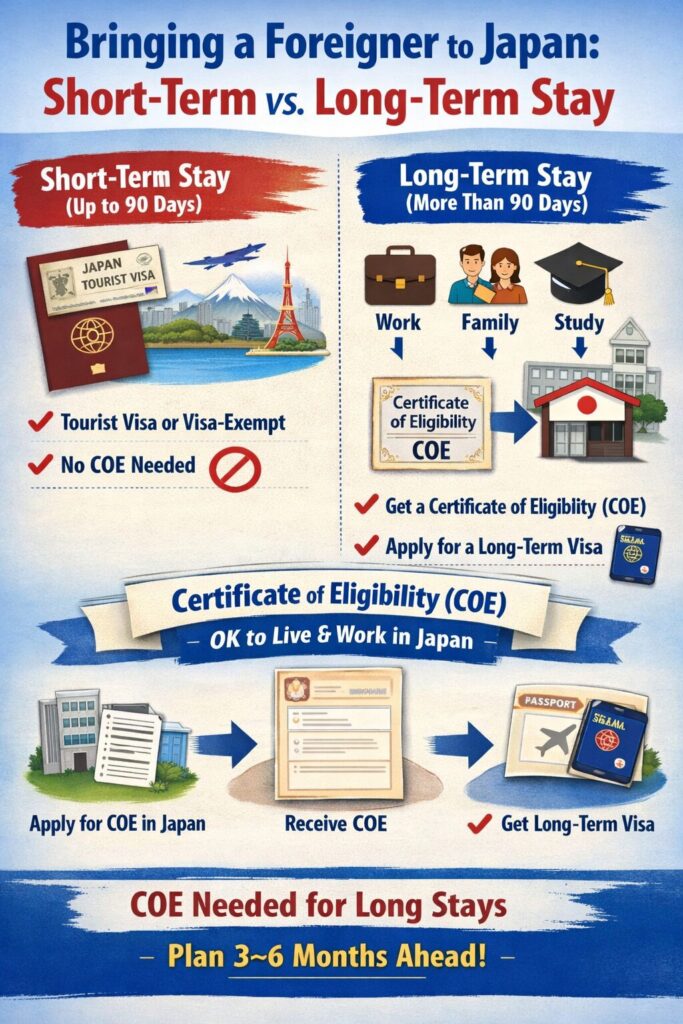
Short-Term vs. Long-Term Stay
There are many different situations in which you may want to invite a foreign national to Japan. The first and most important point to consider is whether the stay will be short-term or long-term.
In general, a short-term stay means up to 90 days.
Short-Term Stay (Up to 90 Days)
If the purpose of the visit is tourism, visiting family or friends, or a short business trip, the foreign national will usually:
-
Apply for a temporary visitor (tourist) visa at a Japanese embassy or visa application center abroad, or
-
Enter Japan without a visa if they are from a visa-exempt country, using only their passport and flight ticket.
In these short-term cases, no application to Japanese Immigration is required in advance.
Long-Term Stay (More Than 90 Days)
If a foreign national wishes to live in Japan for more than 90 days, they must obtain an appropriate status of residence that matches their purpose of stay.
Typical examples include:
-
Working in Japan as an employee
-
Living in Japan with family members
-
Studying at a school or university in Japan
In these situations, a person or organization inside Japan usually submits an application to Immigration before the foreign national comes to Japan.
This application is called the Application for a Certificate of Eligibility (在留資格認定証明書交付申請).
What Is a Certificate of Eligibility (COE)?

Certificate of Eligibility (COE), Paper-based.
A Certificate of Eligibility (COE) is a document issued by Japanese Immigration after it confirms that the planned activities in Japan meet the legal requirements of a specific status of residence.
Simply put, it is like a recommendation letter from Japanese Immigration saying:
“We have reviewed this person in advance, and we believe they are eligible to live and engage in activities in Japan.”
If the application is approved, the COE will be issued either electronically or on paper.
After the COE Is Issued
Once the COE is issued, about 80% of the process is already complete.
The COE is sent to the foreign national, who then:
-
Applies for a visa at the Japanese embassy or consulate in their home country (or country of residence)
-
Receives a visa sticker in their passport, usually within a few days
-
Travels to Japan and undergoes final immigration inspection at the airport
Our office can assist up to the COE application in Japan. Visa applications at Japanese embassies abroad must be handled directly by the applicant.
Important Limitations
In principle, it is not possible to enter Japan on a tourist visa and later change it to a long-term status.
(There are exceptions, which are explained below.)
Additionally, there are cases where a COE cannot be applied for, such as:
-
Certain special or exceptional visa categories (e.g. same-sex partner cases)
-
Situations where there is no sponsor or contact person in Japan
Alternatives When a COE Cannot Be Applied For
In such cases, there are two possible approaches:
-
Applying for a COE after entering Japan
The foreign national enters Japan first and then applies for their own COE.
This may sound unusual, but it is legally permitted and not uncommon. -
Applying for a visa directly at a Japanese embassy without a COE
All documents prepared in Japan are sent abroad, and the entire visa application is handled by the embassy.
Because there is no COE, the screening process usually takes longer.
In some cases, the embassy may consult Japanese Immigration through the Ministry of Foreign Affairs.
Processing Time and Timing Tips
COE issuance usually takes 1 to 3 months after submission to Immigration. Including embassy procedures, you should start preparing 3 to 6 months before the intended date of arrival.
A COE expires 3 months after issuance, so applying too early is also not recommended.
Exception: Changing Status After Entry
Although changing status after entering Japan on a tourist stay is generally not allowed, there is an important exception:
If a COE is issued while the person is already in Japan as a temporary visitor, they may apply for a Change of Status of Residence directly at Immigration.
This allows them to avoid returning to their home country for a visa application.
However:
-
Student visas require documents and approval from the school
-
Work visas require new documents and consent from the employer
Without cooperation from the school or company, this option cannot be used.
[LINK]
- [FAQ] I obtained a COE while I was in Japan. What do I need to do after that?
- Change of status from Temporary Visitor (Tourist) Visa to Spouse Visa and Other Visas
Please feel free to contact us for advice!
First, please call +81-3-6264-9388 or leave a message on our website with your inquiry. (Please contact us by phone or consultation page.)
TEL: +81-3-6264-9388
Email: info@lawoffice-yokoyama.com