![JAPAN VISA [YOKOYAMA LEGAL SERVICE OFFICE]](https://lawoffice-yokoyama.com/wp/wp-content/uploads/2014/10/logo_024.png)
コンテンツ
- Can Foreign Residents in Japan Run a Shopee Side Business?
- Visa Requirements and Immigration Procedures Explained by a Legal Specialist
- What Is Shopee and How Is It Legally Classified in Japan?
- Why Shopee Sellers Need Immigration Permission in Japan
- Two Types of Work Permission: Comprehensive vs. Individual
- Comprehensive Permission “Houkatsu Kyoka包括許可“(Up to 28 hours per week)
- Individual Permission ”Kobetsu Kyoka個別許可”(Required for Shopee Businesses)
- Immigration Review Criteria for Individual Permission
- When a Business Manager Visa Becomes Necessary
- The Importance of Detailed Explanation Documents
- Can Engineer / Specialist Visa Holders Run Shopee Stores?
- Why Professional Legal Support Matters
- Conclusion
- Useful link
Can Foreign Residents in Japan Run a Shopee Side Business?
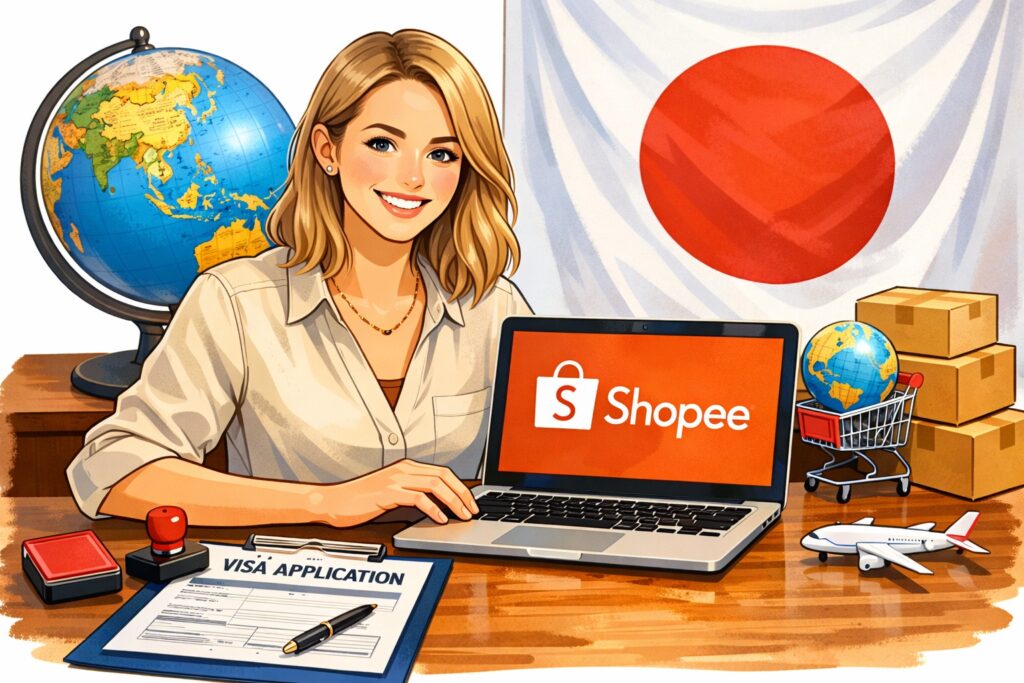
Visa Requirements and Immigration Procedures Explained by a Legal Specialist
As cross-border e-commerce in Southeast Asia continues to grow rapidly, many foreign residents in Japan are exploring Shopee as a side business opportunity.
Shopee allows individuals to sell products internationally with low startup costs, making it highly attractive for housewives, students, and professionals living in Japan.
However, from a Japanese immigration law perspective, earning income through Shopee without proper authorization can violate visa regulations.
In most cases, foreign residents must obtain
Permission to Engage in Activities Other Than Those Permitted by Their Current Status of Residence.
This article explains the legal framework, immigration practice, and approval requirements in detail.
What Is Shopee and How Is It Legally Classified in Japan?
Shopee is a Singapore-based e-commerce marketplace widely used across Southeast Asia and Taiwan.
From a Japanese legal standpoint, Shopee selling activity is classified as:
Export-oriented commercial activity conducted within Japan.
Even though customers are overseas, the business operations — product sourcing, listing, shipping, and revenue management — occur in Japan.
Therefore, Shopee sales are fully subject to Japanese Immigration Control and Refugee Recognition Act regulations.
This point is frequently misunderstood by foreign residents.
Why Shopee Sellers Need Immigration Permission in Japan
Under Article 19 of Japan’s Immigration Act, foreign nationals are strictly limited to activities permitted by their specific visa category.
Typical visas such as:
- Dependent Visa (Family Stay)
- Student Visa
- Engineer / Specialist in Humanities / International Services Visa
do not include commercial business activities.
Operating a Shopee store constitutes income-generating business activity outside the permitted scope.
Therefore, foreign residents must obtain:
Permission to Engage in Activity Other Than That Permitted (Shikakugai Katsudo Kyoka).
Failure to obtain this permission may lead to:
- Visa renewal denial
- Status revocation
- Negative impact on permanent residence applications
Two Types of Work Permission: Comprehensive vs. Individual
Japanese immigration practice recognizes two permission types.
Comprehensive Permission “Houkatsu Kyoka包括許可“(Up to 28 hours per week)
This applies mainly to part-time employment where:
- Working hours are clearly defined
- An employment contract exists
Typical examples include convenience store jobs or restaurant work.
Approval is generally straightforward.
Individual Permission ”Kobetsu Kyoka個別許可”(Required for Shopee Businesses)
Shopee selling falls under Individual Permission because:
- Working hours cannot be objectively measured
- No employment relationship exists
- The seller operates as a sole proprietor
E-commerce activities are treated as self-managed business operations.
Immigration Review Criteria for Individual Permission
Immigration authorities evaluate multiple factors, including:
-
Primary visa activities must remain the main focus
-
The side business must not interfere with permitted activities
-
Business legality and compliance
-
Good conduct of the applicant
-
Small-scale nature of operations
-
Income level not exceeding sponsor support (for dependent visas)
-
Contracting company consent (for work visas)
-
No indicators of business management scale
-
Defined activity period
-
No violation history
The most critical concepts are:
small-scale operation and subsidiary nature of the business.
If immigration determines the activity is effectively a full business operation, a Business Manager Visa may be required instead.
When a Business Manager Visa Becomes Necessary
Individual permission is not sufficient if the seller:
- Establishes a corporation
- Hires employees
- Rents office space
- Operates at large commercial scale
These activities fall under business management and require a status change.
The Importance of Detailed Explanation Documents
Unlike comprehensive permission, individual permission requires extensive documentation.
Applicants must explain:
- Business model
- Product categories
- Estimated income
- Working time structure
- Impact on primary visa activities
- Proof of small-scale operation
There is no fixed format.
The logical consistency and legal framing of these documents heavily influence approval.
Can Engineer / Specialist Visa Holders Run Shopee Stores?
Yes — but only through Individual Permission.
Comprehensive permission is not available.
Employer consent may also be required in certain cases.
Why Professional Legal Support Matters
Shopee side businesses may appear simple.
However, immigration authorities carefully evaluate:
whether the activity exceeds “side business” scope.
Poor documentation often results in:
- Long processing delays
- Additional evidence requests
- Application denial
Professional legal structuring significantly improves approval outcomes and long-term visa security.
Conclusion
Shopee provides excellent business opportunities for foreign residents in Japan.
But operating legally requires proper immigration authorization.
In most cases:
Individual Permission to Engage in Activities Other Than Permitted is mandatory.
Correct legal planning protects your visa status and future residency prospects.
Useful link
- Visa Permission for the Second job
- Visa Rules for Foreign English Teachers in Japan
- Understanding Work Visa Regulations for Second Jobs in Japan
- Recommended Shopee Cross-Border Seller: Tokyo Daily Market
Other Question?

Please feel free to contact us for advice!
First, please call +81-3-6264-9388 or leave a message on our website with your inquiry. (Please contact us by phone or consultation page.)
TEL: +81-3-6264-9388
WeChat: visa_hengshan
Line ID: visa_yokoyama
Email: info@lawoffice-yokoyama.com